Bow Mind 弓心 title plate: vertical Chinese characters 弓 and 心 stacked above the English wordmark and the tagline ‘Where Archery Meets Mindfulness’, set in white on black.
XTDesign · Interactive Installation · 2025

Bow Mind 弓心

An installation that turns the digital instruments of the attention economy back inward — EEG, mmWave radar, a recurve bow — used together as a slow discipline of watching yourself. Research presented at ADADA 2025.

Year
2025
Research in progress
Type
Interactive installation
Biofeedback research
Methods
EEG focus headset · mmWave radar
Real-time visualization · Recurve archery
Project
Solo research
ADADA 2025 paper
Recognition
Bow Mind: An Interactive Archery System for Mindfulness Practice · ADADA 2025 (Asia Digital Art and Design Association) · Paper on J-STAGE ↗
Page in progress. This case develops alongside the thesis it belongs to. The work was presented as a paper at ADADA 2025; the rest of this case (apparatus diagrams, prototype iterations, studio documentation, user-test findings, two-month home study) will arrive in waves as the thesis moves toward defense.
01 · Imagine

Contemplation with the bow.

Project showreel · the studio scenes here are video stills, not the final apparatus photography (to come).

02 · Research proposal

Pointing the sensor inward.

Bow Mind is a working installation built around a small, stubborn question: what if the digital tools that pull us outside ourselves could be turned back inward? A consumer-grade EEG headset reads the focus rhythm of the brain; a contact-free mmWave radar watches the breathing and the pulse; a screen translates that data into a slow visual companion, so the participant can see, in real time, the shape of their own attention. Then they pick up a recurve bow.

I keep coming back to the same feeling behind it. Not crisis, not depression, just the slow drift of attention away from yourself. The word the early critics of industrial life used for that condition was alienation; it hasn’t gone away in our era, it has gathered new layers. First it was alienation from our work, then from our consumption, and now, with the always-on social internet, from our relationships themselves. The most ordinary act, checking a feed, quietly installs someone else’s value-system between you and your own life.

Heidegger called this condition Das Man, the They: the impersonal voice you live by when you have stopped asking what you think. Authenticity, for him, is not moral purity — it is the much harder act of owning the life you are already living. Not retrieving a buried true self; taking up your everyday existence as yours. If alienation is the diagnosis, the prescription has to begin with someone waking up inside their own life, not somewhere else.

How does that waking up actually happen? Merleau-Ponty answers with the body. Meaning begins in embodied experience before it is named: before you can think about your attention, your breath has already chosen its pace, your shoulders have already softened or tightened, the eye has already settled or scanned. So this project asks the same body that the apparatus is built around to do the work of attending. A headset, a radar, a screen, used not to broadcast to others but to watch yourself. The technologies that ordinarily pull us outside might, designed differently, point us back. Human-centered design is not only about ease of use; it can also be a path away from alienation, instead of one more way into it.

Archery is the discipline I chose because it makes attention legible in the body. A bow cannot be drawn well by gripping harder; the body learns, over many releases, to let go of the very control it thought was the point. Practiced this way, target shooting becomes a slow physical training in coexisting with your own state rather than fighting it. The hypothesis is small enough to test, and large enough to matter: when digital sensing is pointed inward instead of outward, paired with a slow embodied discipline, can it help a person come back into contact with themselves?
03 · A session

The final concept.

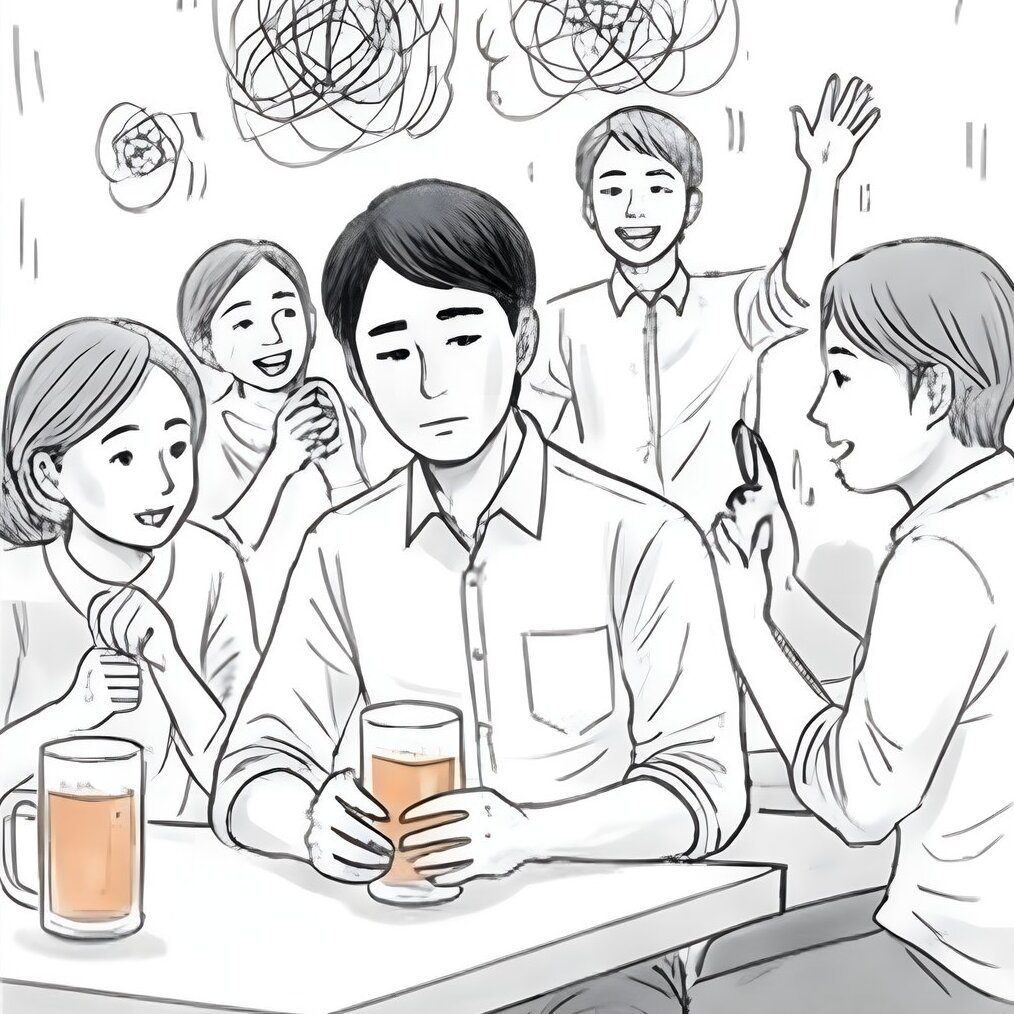
A young man sits at a noisy izakaya dinner with colleagues, holding a half-drunk beer. The colleagues are laughing animatedly; he is physically there but mentally somewhere else, with chaotic scribble-lines floating above his head.
01 · Drained Surrounded but absent, the day's noise still in him.
He leaves the lit izakaya alone, hands in pockets, head slightly down. The scribble noise above his head has thinned.
02 · Leaving Out into the night, the noise thinning behind him.
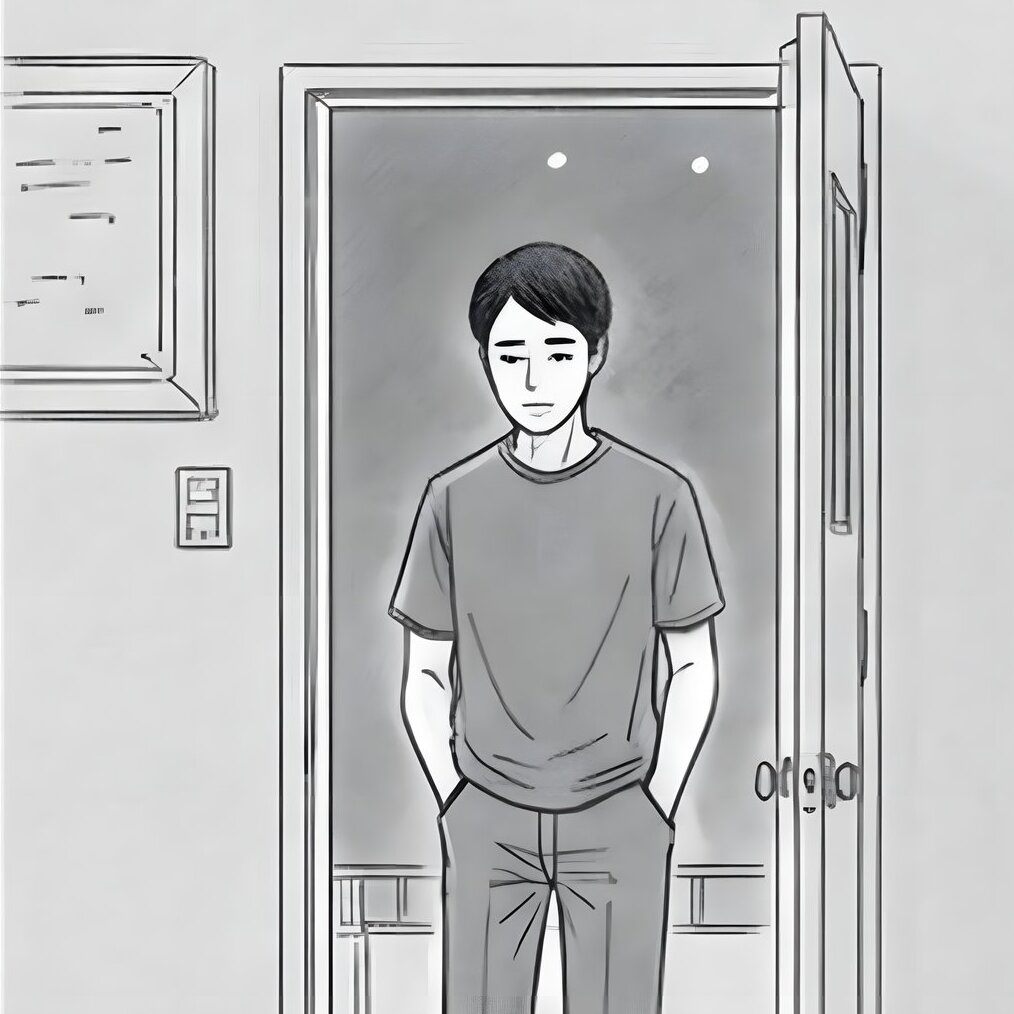
Now in a T-shirt and jeans, he stands at the doorway of a quiet studio room: a recurve bow on a stand on one side, a projection screen glowing faintly amber on the other. He exhales, shoulders dropping.
03 · Arrival The studio is quiet. He notices the bow on its stand.
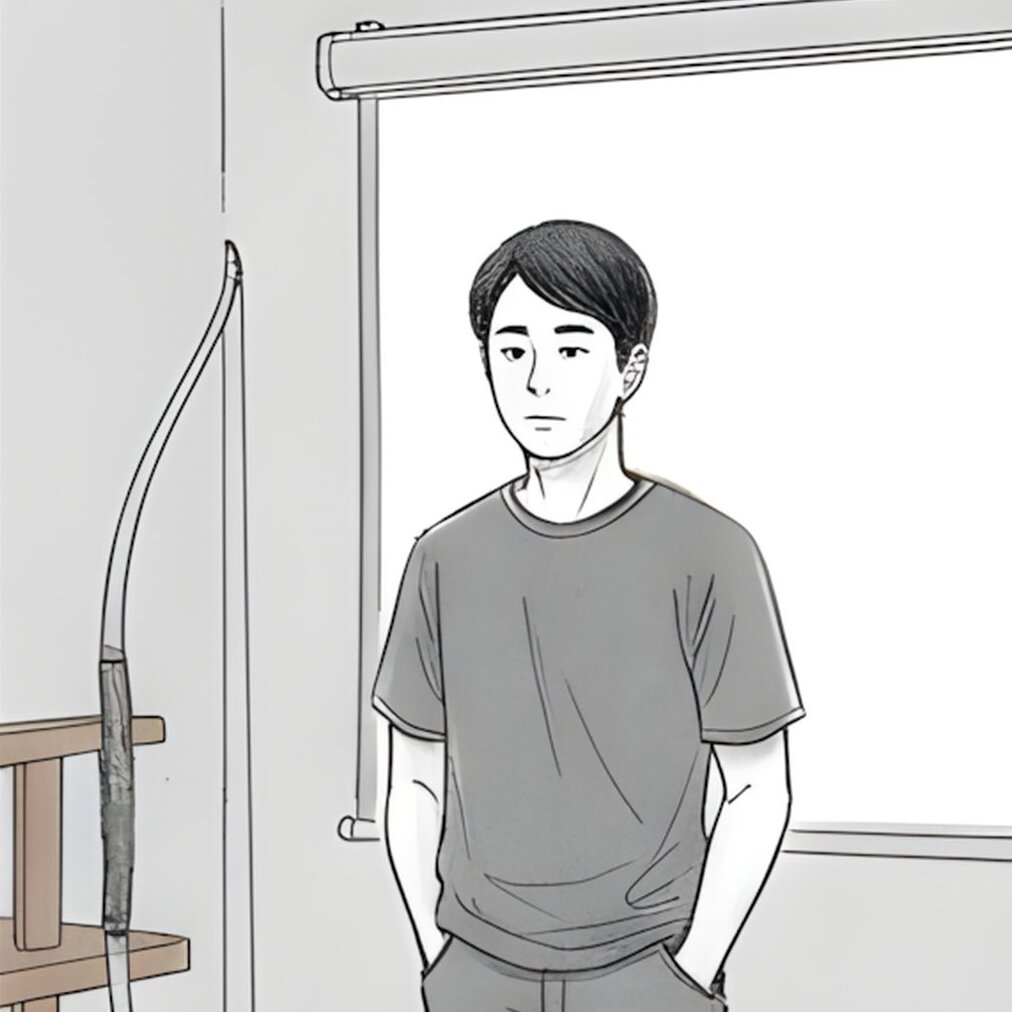
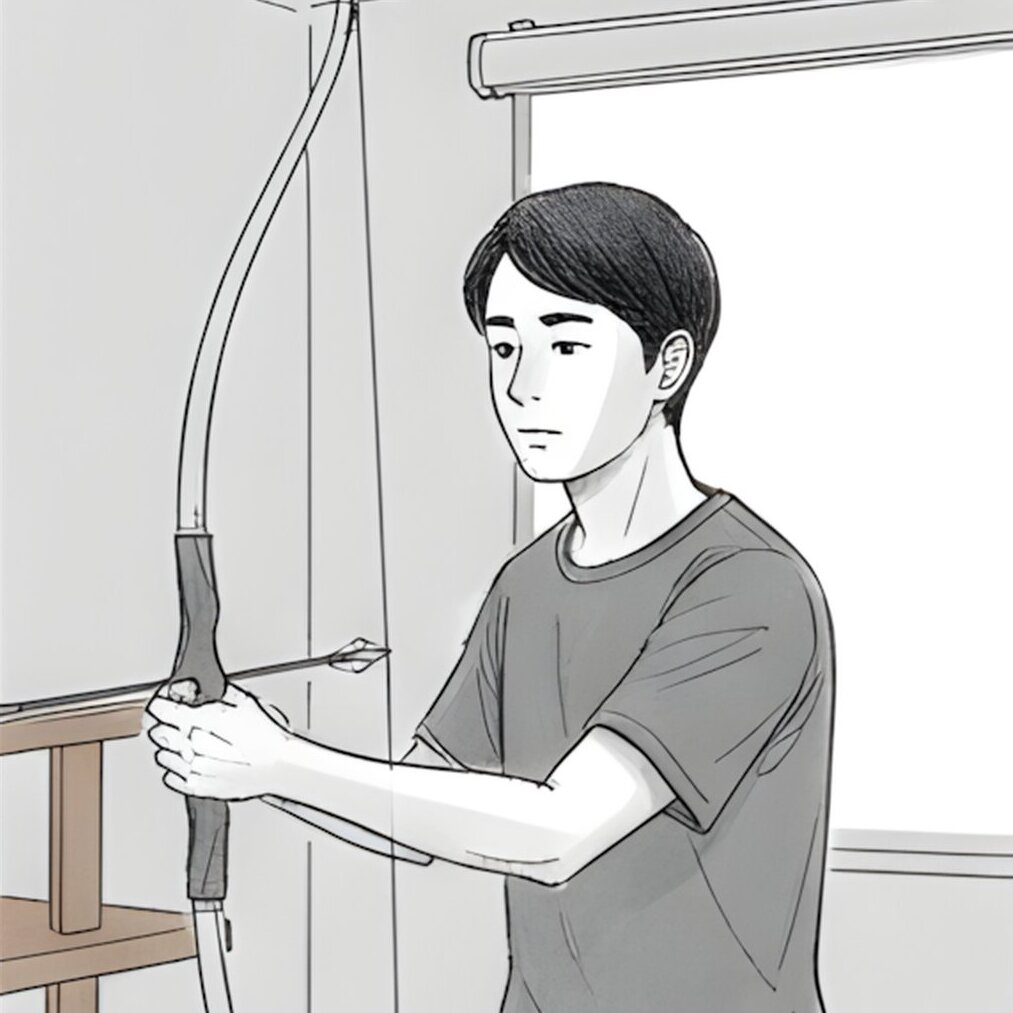
He picks the recurve bow up from its stand, weighing it in his lead hand. Calm and deliberate.
04 · Picking up The weight of the bow in the hand. Something settles.
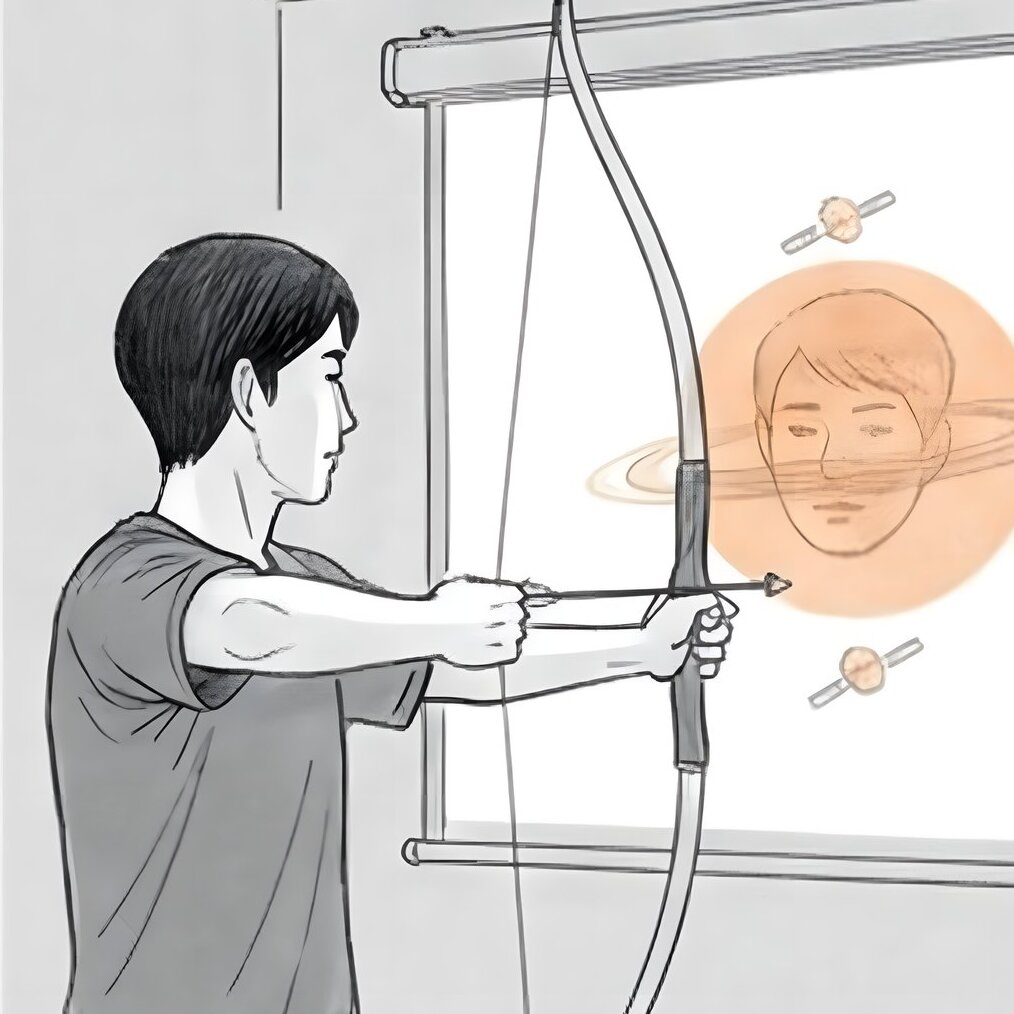
Standing in three-quarter view, he draws the recurve bow toward a projection screen on the wall. The screen shows a warm amber planet with his own face mirrored faintly on its surface, ringed by small satellites.
05 · Practice Drawing toward his own face on the planet.
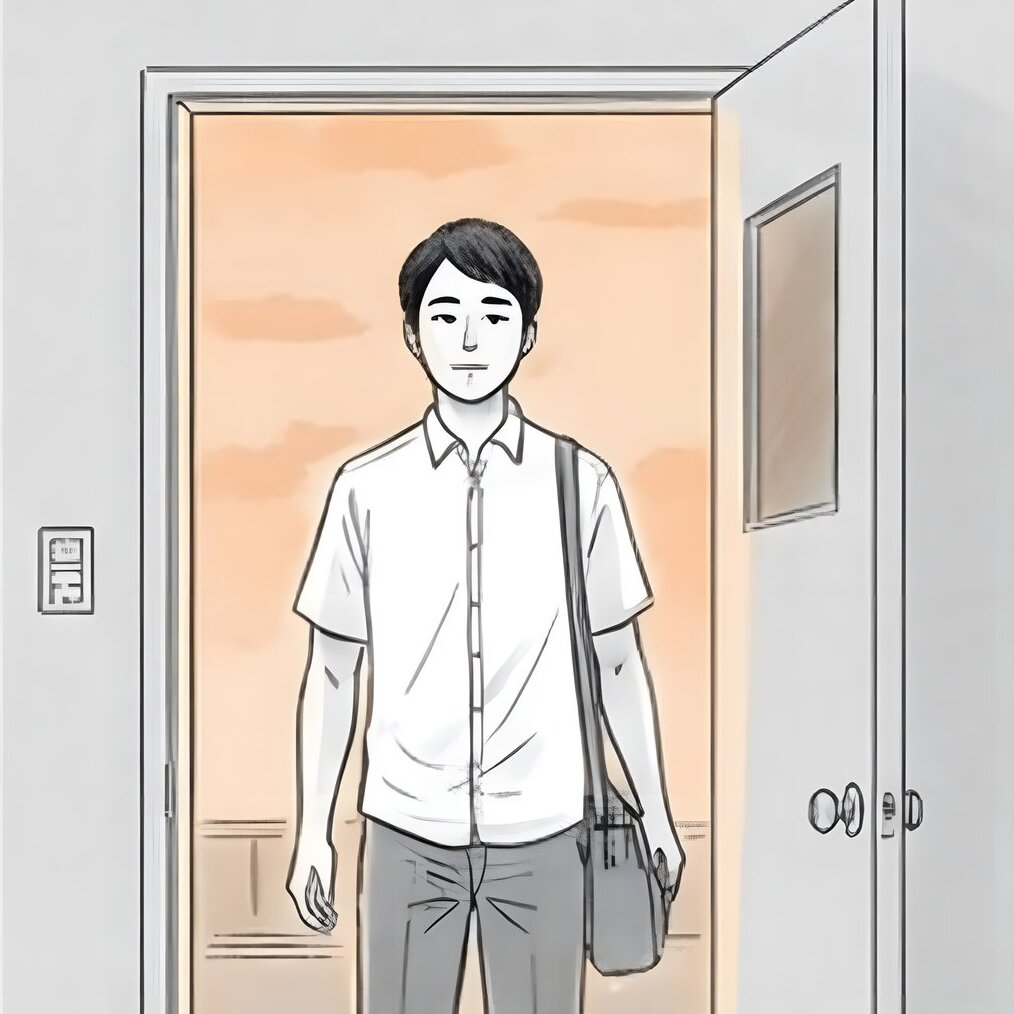
He walks out through a doorway into early-evening light, bag over one shoulder, posture open and unhurried. A soft amber glow on his face from the sunset.
06 · Refreshed Out the other side, lighter than he came in.

The scribble noise above his head in panel one is what we are trying to thin out by panel six.

04 · From three storyboards to one

What the archers told me.

I started with three storyboards. A digital bow with sensor-fins that twitched when your mind went scattered. An emotion lamp that brightened when you settled down. And an emotion bubble screen where bad feelings floated up and you shot them.

I took all three to three different archers: my own student-club instructor, a competition coach, and a kyudo (Japanese archery) teacher.

The instructor said one thing I keep coming back to. When something big comes up at the line, a shot you keep replaying, a feeling you didn’t expect, the way through, he said, is “first you step away from it, then you accept it, then you resolve it.” None of my three storyboards left room for the middle step. The emotion bubble was the worst of them: it asked you to shoot the feeling out of the sky, which is basically the opposite of accepting it.

The kyudo teacher pulled something else out. I had been writing the project as a tool for self-cultivation, quietly assuming anyone who picked up a bow wanted their inner life polished. He told me, very calmly, that if that were the goal he would just go sit at a temple, and that he himself had not picked kyudo for it. I wrote that down. Bow Mind had to work for people who had not signed up for any of the mindfulness stuff in the first place.

So three storyboards became one. A single target, slow and quiet, at the centre of a star-field. The planet at the centre carries the participant’s own camera image on its surface. Satellites orbit it at the speed of the heart. The colour of the planet follows your focus, not as a score, just as a colour. You are not aiming at an emotion to delete it. You are aiming at the place where you are watching yourself.

The hardware had to answer the archer’s hand the way the bow does, so the controller is a real recurve. A magnetic sensor in the riser detects the draw; an infrared aimer, with firmware borrowed from an open-source light-gun project, is paired by Bluetooth. No game pad. The muscle memory has to be the muscle memory.